Sometimes I think we make New Zealand more complicated than it needs to be.
We are a country of just over five million people.
We have land. We have water. We produce food the world wants. We generate most of our electricity from renewable sources. We have good universities, scientists, entrepreneurs and educated people.
We have stable institutions, the rule of law and an international reputation that many countries would be pleased to have.
These are substantial advantages.
Yet we have been talking about New Zealand's productivity problem for years.
The reports keep coming.
The strategies keep coming.
The reviews keep coming.
And still, we ask essentially the same question:
How does New Zealand become a genuinely high-income, productive economy?
I wonder whether part of the answer is much simpler than we make it.
We keep changing direction.
Not everything changes every three years, of course. Governments must be able to change bad policy. Circumstances change. Technology changes. The world changes.
But there is a difference between changing a policy that is not working and repeatedly changing the country's economic direction.
That distinction matters.
A business making a major investment does not think three years ahead.
A scientist developing new technology does not think three years ahead.
A company deciding whether to establish a research operation in New Zealand does not think three years ahead.
An investor considering a major energy project does not think three years ahead.
These decisions can take ten, twenty or thirty years to produce their full return.
Our political cycle is three years.
Our economic ambitions cannot be.
What are we trying to become?
This, to me, is the more interesting question.
I do not think New Zealand's future lies in trying to become a low-cost manufacturing country.
We cannot compete with the scale of China, India or the United States. I am not sure why we would try.
Nor do I think the answer is simply producing greater quantities of the things we already produce.
That may increase total output.
But it does not necessarily create the high-income economy we should be capable of building.
I think we need to change the question.
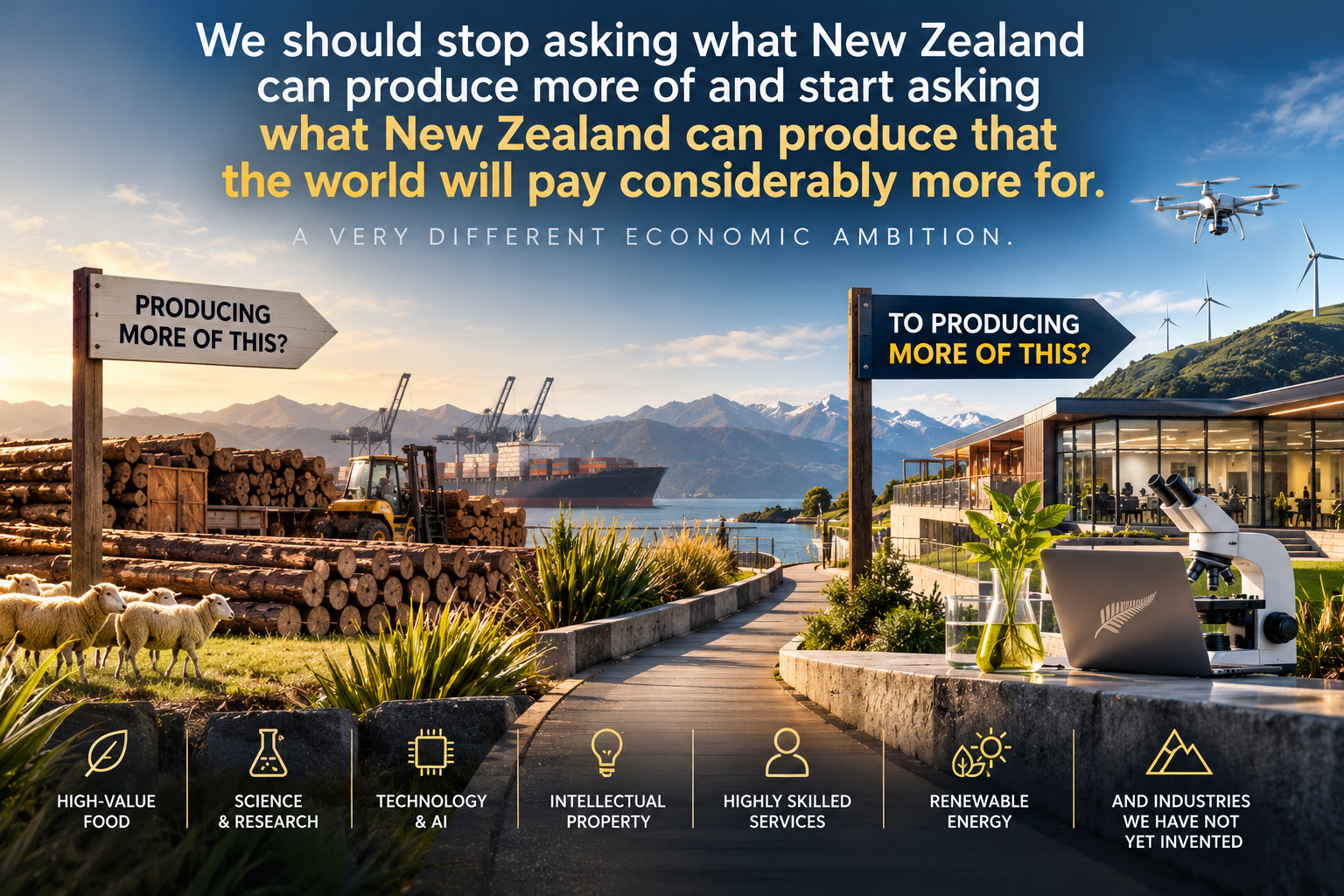
We should stop asking what New Zealand can produce more of and start asking what New Zealand can produce that the world will pay considerably more for.
That is a very different economic ambition.
Don't just sell the milk
Take food.
Food and fibre exports are forecast to reach $64.3 billion in the year to June 2026.
That is an enormous national strength.
But the next question should not automatically be:
How do we produce more?
It should also be:
How do we make what we produce more valuable?
Not simply milk.
Nutrition.
Food science.
Specialised proteins.
Premium ingredients.
Genetics.
Medical and functional foods.
Agricultural robotics.
Precision agriculture.
Intellectual property.
Not simply fruit.
Plant science.
New cultivars.
Automation.
Premium products developed for particular international markets.
Not simply water.
Water science.
Monitoring.
Purification.
Irrigation technology.
Environmental management.
The same hectare of land can ultimately support very different levels of national income depending upon the science, technology, intellectual property and expertise wrapped around what it produces.
That is where I think the opportunity lies.
Not necessarily more. More valuable.
And not only food
The same principle applies across the economy.
Agri tech.
Biotechnology.
Medical technology.
Robotics and autonomous systems.
Artificial intelligence.
Space and aerospace.
Marine technology.
Geothermal expertise.
Environmental monitoring.
Advanced materials.
Cybersecurity.
Digital services.
Creative technology.
Research and intellectual property.
Highly specialised professional services.
And industries that do not yet exist.
But I would be very careful about turning that into a government list of industries that somebody has decided must succeed.
Nobody knows with certainty which industries will dominate in 2047.
I certainly don't.
The objective should be bigger than picking winners.
Build an economy in which valuable ideas have a reasonable chance of becoming valuable businesses here.
That is the economy I am interested in.
Technology changes what being small means
For much of our history, New Zealand's distance from major markets was an obvious disadvantage.
A container has to travel.
A digital product does not particularly care whether it was developed in Auckland, Boston or Singapore.
Intellectual property does not need a container ship.
Neither does software.
Neither does an algorithm.
Neither does specialist advice delivered digitally.
That changes the economics of being small.
A New Zealand company no longer necessarily needs offices in twenty countries to sell into twenty countries.
Five exceptionally capable people using technology can sometimes produce what once required fifty.
For a country of our size, that should be an opportunity.
We do not necessarily need more people doing more things.
We need people producing more value from each hour of work.
That distinction matters.
AI is a good example
New Zealand released its first national artificial intelligence strategy in 2025.
Its basic premise is sensible.
We are not going to outspend the United States or China developing the world's largest foundational AI models.
Why would we try?
The more interesting question is what AI allows New Zealand to become exceptionally good at.
Agriculture.
Medicine.
Food science.
Engineering.
Environmental management.
Professional services.
Education.
Logistics.
Research.
For a small country, adoption itself can be a competitive strategy.
We do not have to invent every important technology.
We need to become exceptionally good at recognising useful technology, adopting it quickly and applying it to areas where we already possess expertise.
A country of five million people should, in theory, be capable of moving quickly.
Sometimes I wonder whether we have turned our small size into an excuse when it should be an advantage.
What happens to the good idea?
This is where I think we need to become much more demanding.
Suppose a scientist at a New Zealand university develops something extraordinary.
What happens next?
Can it obtain capital here?
Can the intellectual property be commercialised here?
Can the business find the specialist people it needs?
Can it move from ten employees to one hundred?
Can it reach international markets?
And when it becomes genuinely successful, can it continue scaling from New Zealand?
That last question matters.
New Zealand's venture-capital market has developed substantially. OECD figures show annual venture investment increasing from around $50 million in 2015 to almost $600 million in 2024.
That is progress.
But the OECD also identifies a problem further along the journey.
Once innovative New Zealand companies move beyond early-stage venture funding and require substantial scale-up capital, the domestic market becomes much thinner.
The OECD says this funding gap is impeding the growth of innovative firms and accelerating the departure of some firms to larger foreign economies, particularly the United States.
That should concern us.
Not because every New Zealand company must remain entirely New Zealand-owned forever.
That would be unrealistic.
Foreign capital can be enormously valuable.
International ownership is not inherently a failure.
The question is different.
When a New Zealand idea becomes internationally valuable, how much of the economic value created by that idea remains in New Zealand?
The research?
The intellectual property?
The headquarters?
The highly paid jobs?
The next generation of entrepreneurs who learn from building it?
The tax base?
The investment returns?
The problem is not simply whether New Zealand can produce good ideas.
We plainly can.
The harder question is whether we can keep enough of the economic value created by those ideas here as they become successful.
Research spending is not the result
The same discipline should apply to research.
New Zealand spends billions of dollars on research and development.
That matters.
But expenditure is an input.
It is not the result.
We should ask what comes out the other end.
A paper?
A patent?
A licence?
A new treatment?
A new technology?
A successful company?
A product sold around the world?
New Zealand has produced genuine commercialisation successes. Existing programmes have supported thousands of projects, hundreds of commercial deals and more than one hundred start-ups.
So, the picture is not one of failure.
But the fact that the system continues to be reformed tells us there is more work to do.
The question I would ask is very simple:
For every dollar New Zealand puts into research, how much enduring commercial value do we eventually create?
That is much harder to measure than research spending.
It is also much more important.
Renewable energy is an economic asset—but only if we use it
In 2025, 88.5 per cent of New Zealand's electricity generation came from renewable sources.
That is the highest proportion since 1981.
Again, I would not treat that merely as an environmental statistic.
It is potentially an economic asset.
But we should not exaggerate it either.
Businesses care about more than the percentage of electricity generated renewably.
They care about price.
Reliability.
Capacity.
Transmission.
And whether enough new generation will be available when they need it.
So the serious question is not:
Do we have renewable electricity?
We plainly do.
It is:
How do we turn that advantage into higher-value economic activity?
What research does it attract?
What computing?
What advanced production?
What technology?
What industries become commercially attractive because they can operate from a predominantly renewable electricity system?
An advantage has limited economic value if we simply admire it.
More exports is not necessarily the same as more value
The same problem arises when we talk about exports.
We celebrate record export numbers.
Fair enough.
Exports matter enormously to New Zealand.
But even here I think we should ask a harder question.
Suppose we export more tonnes and receive more dollars.
Have we necessarily become more productive?
Not necessarily.
Export values can rise because prices rise.
Volumes can rise.
Exchange rates move.
Commodity prices change.
The composition of exports changes.
The June 2026 quarter provided a useful illustration. Goods export volumes increased by 6.4 per cent and export values by 6.7 per cent, while New Zealand's merchandise terms of trade fell sharply.
One quarter proves very little about the long-term economy.
But it demonstrates why volume and value are not the same thing.
I am less interested in celebrating another tonne leaving the wharf.
I am interested in how much value New Zealand captures from that tonne before it leaves.
That takes us back to the central question:
What can New Zealand produce that the world will pay considerably more for?
Serious investment also needs continuity
None of this happens without capital.
And serious capital needs confidence.
An investor can calculate wages.
An investor can calculate tax.
An investor can calculate land, electricity and financing.
What is much harder to calculate is whether the rules governing a twenty-year investment will repeatedly change.
The OECD's 2026 examination of New Zealand makes this point directly.
It says consistency and predictability in policy settings are crucial to investors and warns that abrupt regulatory changes can undermine investor confidence.
That is hardly surprising.
Capital does not particularly like surprises.
Neither does research.
Neither does infrastructure.
Neither does somebody deciding whether to build a substantial business here for the next twenty years.
This does not mean policies should never change.
Bad policies should change.
Governments must govern.
Circumstances change.
Technology changes.
But the destination does not have to change with them.
We do not have to agree about everything
New Zealand is a democracy.
We will disagree.
We should.
We can disagree about tax.
We can disagree about regulation.
We can disagree about the size of government.
We can disagree about how programmes should operate.
But we are also a country of only a little over five million people.
Surely, we don't have to disagree about everything.
Could we not agree that twenty years from now New Zealand should have:
A substantially more productive economy.
Higher real incomes.
More valuable exports.
Much stronger commercialisation of New Zealand research.
More intellectual property developed here.
Greater adoption of useful technology.
More successful companies capable of selling globally from New Zealand.
And an economy extracting more value from our natural advantages rather than simply extracting greater volumes from them.
Those objectives do not belong to one political philosophy.
They are New Zealand objectives.
The argument can then be about how we get there.
That is where politics belongs.
Five objectives. Twenty years.
Perhaps we need something much simpler than another enormous economic strategy.
Five national economic objectives.
Twenty years.
Measure them every year.
Publish the results.
Let different governments pursue them differently.
If a policy fails, change it.
If technology changes, adapt.
If circumstances change, respond.
But keep the destination.
And don't measure success simply by saying GDP increased.
Total GDP can grow because the population grew.
Nor should we congratulate ourselves simply because exports increased.
I would want to know something more fundamental.
Is New Zealand becoming more valuable per person?
The Money & State Five
If I had to reduce the question to five numbers, these are the ones I would watch.
1. How much value do we produce per hour worked?
Real GDP per hour worked.
Not simply total GDP.
Not simply how many hours New Zealanders work.
What does one hour of New Zealand labour produce?
Our employment and labour-force participation have traditionally been relatively strong.
The persistent problem is productivity.
Working longer is not the same as becoming wealthier.
Producing more value from each hour is.
2. What does the middle New Zealander earn for an hour of work?
Not nominal wages.
Real median hourly income after inflation.
Productivity statistics mean rather less to ordinary households if the gains never reach them.
So put the two numbers beside each other.
How much value does New Zealand produce per hour?
How much does the person in the middle receive per hour?
Over twenty years, I would want both moving decisively upwards.
3. How much export value do we generate per worker?
Not merely export tonnage.
Not merely headline export dollars.
Value.
And underneath that number I would want to know what we are actually selling.
Technology?
Intellectual property?
High-value services?
Premium food?
Scientific expertise?
Or largely greater quantities of commodities?
This is where we discover whether New Zealand is moving up the value chain or simply becoming better at producing more.
4. How successfully do we turn research into commercial value?
Do not tell me only how much we spent on R&D.
Tell me what happened afterwards.
Licensing revenue.
Private capital attracted.
Businesses created.
Products commercialised.
Intellectual property retained.
Companies successfully scaled.
Measure commercial outcomes against the public and private money invested in research.
Research is important in its own right.
But if we are discussing economic policy, eventually we have to ask what economic value it creates.
5. How many New Zealand companies scale globally while keeping high-value activity here?
This may be the hardest measure.
It may also be one of the most revealing.
How many New Zealand-founded businesses become substantial global companies while retaining meaningful research, intellectual property, headquarters functions or highly skilled employment here?
I am not interested in preventing companies from accepting foreign investment.
Quite the opposite.
The objective is not economic isolation.
It is ensuring that when New Zealand produces something internationally valuable, New Zealand continues to participate meaningfully in the value that follows.
Those are five numbers worth publishing.
Then publish exactly the same five next year.
And the year after that.
And the year after that.
For twenty years.
We would soon discover whether we were actually becoming a high-income economy—or simply talking about becoming one.
What does New Zealand have that others cannot easily copy?
This may be the question underneath all the others.
Not everything we possess is unique.
Other countries have universities.
Other countries have technology.
Other countries have clever people.
Other countries have renewable energy.
But advantages become much more interesting when they are combined.
Our food reputation.
Our agricultural expertise.
Our renewable electricity.
Our natural environment.
Our scientific capability.
Our stable institutions.
Our rule of law.
Our position in the Asia-Pacific.
Our international reputation.
Our relatively small and connected society.
Put those together and perhaps there are opportunities we have not thought seriously enough about.
We should not try to become Singapore.
We should not try to become Australia.
We certainly cannot become America.
We need to become a much more valuable version of New Zealand.
We already know quite a lot about the problem
In December 2025, MBIE and MFAT published a long-term briefing examining how New Zealand could accelerate the growth of high-productivity activities through to 2050.
The OECD continues to identify productivity, investment, innovation, technology adoption and access to growth capital as structural issues for New Zealand.
Treasury has described productivity as one of New Zealand's central long-term economic challenges.
So another report telling us that New Zealand has a productivity problem is unlikely, by itself, to change very much.
We know.
At some point we have to decide where we are going.
Then keep going.
We are very good at starting again
New Zealand has already been given many of the ingredients.
Land.
Water.
Food.
Energy.
Education.
Science.
Stable institutions.
A good international reputation.
And access to a rapidly growing Asia-Pacific region.
Perhaps our greatest shortage is not another natural resource.
It is continuity.
Because there comes a point when another strategy, another review and another change of direction stop being evidence that we are searching for the answer.
They become part of the problem.
We are very good at starting again.
Perhaps it is time we became better at continuing.
And while we are doing that, perhaps we should change the question.
Not:
What can New Zealand produce more of?
But:
What can New Zealand produce that the world will pay considerably more for?
That is the economy I want us to start talking about.